Flying butterflies are easily one of the most requested and visually striking elements in modern event design. They add an ethereal, magical touch to weddings, stage shows, and grand entrances. However, behind those mesmerizing 5-minute clips on Instagram lies a complex technical setup that most clients never see.
To help event and wedding planners, hosts, and couples set realistic expectations, here is an absolute, point-by-point breakdown of how these devices actually function, their practical drawbacks, and how to execute them successfully.
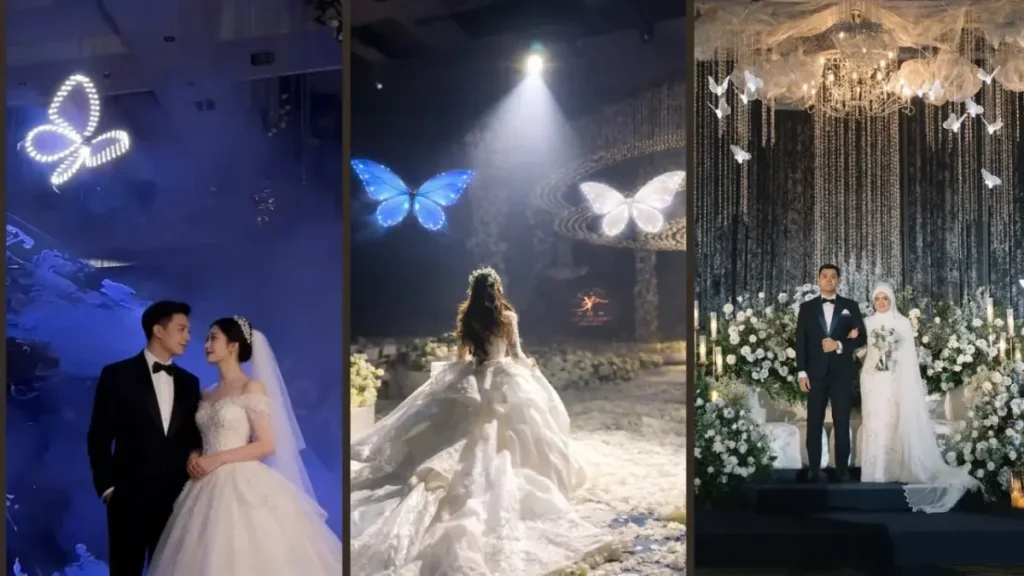
1. How Flying Butterflies Actually Work
Many people assume these are heavy, motor-driven drones, but their real mechanics are far more delicate:
- Micro-Motor Mechanics: Inside each butterfly is a miniature motor designed exclusively to move the two main wings (leaves) up and down. It does not power sustained directional flight like a multi-rotor drone.
- Wind-Dependent Flight: The device relies almost entirely on ambient air currents and wind movement to drift through the air.
- Micro-Sized Battery: The onboard battery is ultra-thin and lightweight. It provides a maximum flight capacity of 2 to 5 minutes (typically operating best around 2–3 minutes). Continuous 30-minute or 1-hour flights are technically impossible.
2. Main Environmental & Operational Drawbacks
Because of their light weight structure, these devices are highly sensitive to their environment.
Indoor Airflow & Drafts
- Helicopter Fans & Ceiling Fans: Heavy drafts from large venue fans destabilize the butterflies immediately.
- AC Chiller Airflow: High-powered industrial air conditioning units in large convention centers create strong down-drafts that pull the butterflies down.
Physical Fragility & Financial Risk
- Onion-Peel Thin Wings: The wings are extremely delicate—roughly the thickness of an onion peel. If strong air forces a wing to bend, the butterfly drops instantly.
- High Replacement Costs: Nearly half the total financial value of the device is in its wings. If a butterfly crashes and breaks a wing, that unit is ruined, leading to significant financial loss.
Outdoor Limitations
- Flying butterflies are not recommended for outdoor wedding venues and events. Uncontrolled outdoor winds will carry the units away, making steering or recovery impossible.
Heat & Battery Drain
- Thermal Overload: Continuous back-to-back testing causes the micro-motor to overheat, forcing the unit to drop.
- Voltage Drop: As soon as the battery charge drops slightly below peak, the butterfly loses lift and descends.
3. Venue Requirements & Technical Safety Limits
To safely fly butterflies at an event, the hall must meet strict structural criteria:
Requirement | Safety Standard | Reason / Impact |
Minimum Height | 14 to 20 Feet | Low ceilings do not allow enough vertical space for stable drifting. |
Chandeliers | Clear / Retracted | Hanging light fixtures trap butterflies. If caught, units can break or get permanently stuck. |
Camera Jibs / Wires | Clear Clearance | Camera cranes, cords, and lighting wires frequently knock down side-flying units. |
Crucial Setup Note: Flying directly over seated guests in the center of a hall looks spectacular, but if chandeliers or low camera rigs are present, we must launch strictly from the sides to prevent crashes.
4. How Professional Operators Manage Risk
To guarantee performance quality on event days, wedding planners and professional operators follow strict protocols:
- Carrying Spare Units: Operating with 6 total units—flying 4 active butterflies while holding 2 full spare units on standby.
- Backup Wing Inventory: Carrying multiple extra set sets of replacement wings on-site to handle sudden damage immediately.
- Custom Flight Cases: Utilizing custom-built protective cases for each butterfly unit and its corresponding remote.
- Pre-Flight Inspection: Running every unit through a dedicated “Checking Mode” before switching into active “Flying Mode.”
- High-End Remote Control Equipment: Using professional-grade transmitters to avoid frequency interference.
5. Expanding Event Offerings
Flying butterflies are just one module in a broader special effects (SFX) lineup. We deliver full-spectrum stage setups in structured, non-repetitive segments:
- Special Effects (SFX): Cold pyros, fog, and specialized stage effects.
- Laser Show Systems: Programmed laser visual sequences.
- 600 Sq. Ft. LED Floor: Interactive lighting floors for stages and dance areas.
- Portable 4×6 LED Display Screens: Compact video wall units for versatile venue placement.
Conclusion
Flying butterflies can transform any event into an unforgettable, fairytale experience. However, beneath the viral clips and visual magic lies a set of technical realities, event and wedding venue limits, and environmental controls that require precise handling by professional event management services. By understanding these operational boundaries and working with experienced professionals who prioritize safety and pre-flight checks, you can ensure a seamless, breathtaking effect on your big day. Ready to add this magical touch to your next grand celebration? Contact our expert team today to discuss venue compatibility and bookings!
What is a flying butterfly FX device?
It’s a lightweight, remote-controlled prop with a tiny onboard motor that flaps two thin wings. It isn’t a drone — it doesn’t power itself through the air like a multi-rotor. Instead it relies on the wing motion plus ambient air currents to drift and glide, giving it a soft, organic flight path instead of a mechanical one.
How long can a flying butterfly actually stay in the air?
Realistically 2 to 5 minutes per charge, with 2–3 minutes being the sweet spot for stable flight. The onboard battery is ultra-thin to keep the unit light, so continuous 30-minute or hour-long flights aren’t possible with this technology.
Can flying butterflies be used outdoors?
They're not recommended outdoors. Because flight depends on air currents rather than powered thrust, uncontrolled outdoor wind can carry the units away entirely, making steering or recovery impossible
What does the venue need for butterflies to fly safely?
A minimum ceiling height of 14 to 20 feet for stable drifting, chandeliers clear or retracted so units don't get trapped, and camera jibs, cranes, or lighting wires kept clear since they can knock a butterfly down mid-flight.
Is it safe to fly them directly over seated guests?
Flying over the center of a seated crowd looks spectacular, but only when the ceiling is clear of chandeliers and low camera rigs. If either is present, operators launch from the sides instead to avoid a crash landing near guests.
What happens if a butterfly's wing gets damaged?
The wings are extremely delicate — about as thin as an onion peel — and hold nearly half the unit's total value. If a wing bends or breaks in a crash, that unit is done for the event, which is why operators travel with backup wing sets and spare units rather than relying on one fragile butterfly per flight.
How do professional operators avoid mid-event failures?
By over-preparing: running six total units so four can fly while two sit ready as standby, carrying extra wing inventory, using custom flight cases per unit, running every butterfly through a pre-flight check before switching it to flying mode, and using professional-grade remotes to avoid signal interference.
What other effects pair well with flying butterflies?
They're often booked alongside cold pyro and fog effects, programmed laser sequences, interactive LED dance floors, and portable LED video wall screens — building toward a fuller stage moment rather than a single standalone effect.