A wedding stage may look simple when guests walk into the venue, but preparing it involves much more than arranging flowers, backdrops, and lighting. Wedding stage production planning is the process of turning an approved stage design into a completed setup while considering the venue, materials, equipment, installation time, and team coordination.
In Kerala, this process can involve additional challenges such as narrow access roads, outdoor venues, monsoon weather, limited unloading areas, and strict installation timings.
At Melodia Event Management, wedding stage production planning involves planning several activities before the wedding day so that the installation can be completed in an organised manner. Alongside full-service wedding planners in Kerala, here is what happens behind the scenes.
Melodia also offers customised wedding stage decoration in Kerala, designed around each couple’s preferences and venue requirements—whether you are planning a traditional Kerala Hindu wedding stage, a Christian wedding stage in Kerala, or a Kerala Muslim wedding stage.
How Does Wedding Stage Production Planning Work?
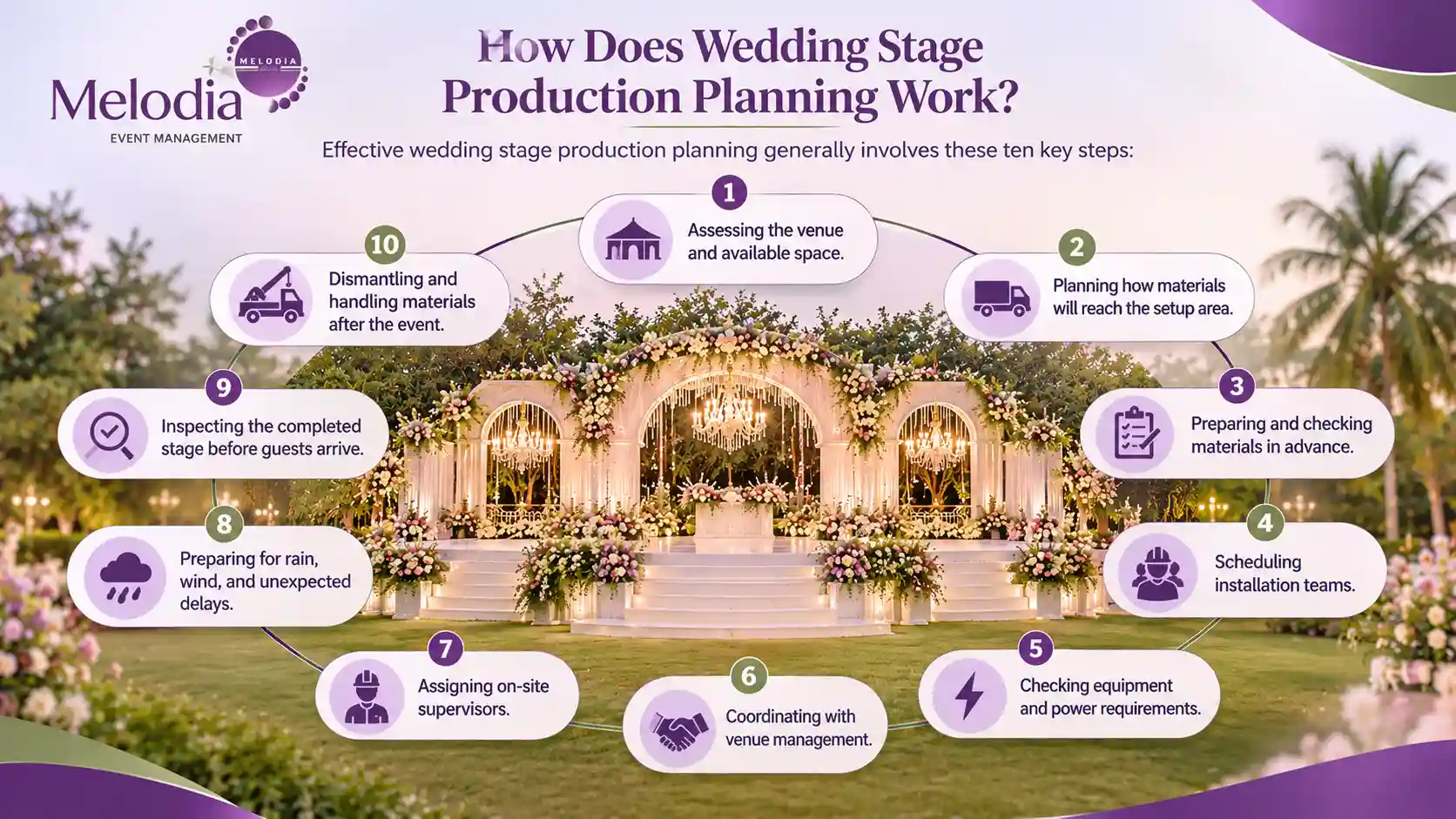
Effective wedding stage production planning generally involves these ten key steps:
- Assessing the venue and available space.
- Planning how materials will reach the setup area.
- Preparing and checking materials in advance.
- Scheduling installation teams.
- Checking equipment and power requirements.
- Coordinating with venue management.
- Assigning on-site supervisors.
- Preparing for rain, wind, and unexpected delays.
- Inspecting the completed stage before guests arrive.
- Dismantling and handling materials after the event.
Each step in wedding stage production planning contributes to a smooth, on-schedule installation.
1. Venue Assessment: Understanding the Space
A stage design that looks impressive in a reference photograph may not be suitable for every location. Before finalising the wedding stage production planning roadmap, the available space and conditions across different wedding venues in Kerala need to be understood.
Important factors include:
- Ceiling height and available stage area
- Floor type and surface conditions
- Entry points and access routes
- Vehicle access and unloading areas
- Available power supply
- Venue restrictions on installation work
For example, a low-ceiling auditorium may not accommodate a tall stage structure. Similarly, a venue with a narrow entrance may require larger structures to be fabricated in smaller sections and assembled at the location.
Identifying these limitations early in wedding stage production planning helps avoid unnecessary changes and installation delays on the wedding day.
2. Planning How Materials Reach the Venue
Transportation and logistics form a major part of wedding stage production planning. Materials cannot always be unloaded directly beside the stage.
In Kerala, some wedding resorts in Kerala, backwater properties, temple halls, and island venues have narrow roads, limited vehicle access, or long distances between the unloading point and the event area.
The production team needs to consider:
- The size and quantity of materials
- Where vehicles can stop and unload
- The distance from the unloading point to the stage
- The number of trips required
- Whether smaller vehicles or manual handling are necessary
- The additional time needed for material movement
A Real Experience from Isola Di Cocco, Poovar
During a destination wedding at Isola Di Cocco, Poovar, vehicles could not reach the main lawn. The team had to carry equipment and decoration materials by hand to the setup area.
This is a practical example of why thorough wedding stage production planning matters—much like managing logistics for a destination wedding in Alleppey. The stage design is only one part of the plan; the team must also map out how every required material will reach the location.
3. Preparing Materials Before They Reach the Venue
A considerable amount of wedding stage production planning happens well before the installation team arrives at the venue.
Frames, backdrops, and decorative structures may need to be fabricated and checked in advance. Having local logistical support—such as our teams handling wedding stage decoration in Kochi, wedding stage decoration in Thrissur, wedding stage decoration in Calicut, and wedding stage decoration in Kottayam—allows larger structures to be divided into smaller sections so that they are easier to transport and assemble at the location.
Before loading, the team needs to check:
- Measurements and dimensions
- Material quantities
- Finishing and quality
- Supporting frames and accessories
- Tools required for installation
Fresh flowers require separate handling because their condition can change during storage and transportation. Their preparation and delivery need to be planned according to the event schedule and weather conditions.
Proper preparation reduces the chances of missing materials and unnecessary delays during installation.
4. Scheduling Teams in the Right Order
A wedding stage involves multiple teams working together. Structural workers, lighting technicians, decorators, and floral teams cannot always begin their work at the same time, which is why clear sequence scheduling is central to wedding stage production planning.
The order of work matters.
For example, the basic structure usually needs to be completed before decorative elements are added. Lighting and music & entertainment technicians may need access to certain areas before the décor covers them. Floral arrangements and finishing touches—including pre-wedding setups like Kerala haldi stage decoration—are generally completed towards the end.
The production schedule should clearly identify:
- Which team arrives first
- What needs to be completed before the next team starts
- The number of workers required for each activity
- Who is responsible for checking the work
- How much time is available for each stage
When the work is properly scheduled, teams can coordinate without unnecessary waiting or repeated work.
5. Equipment and Power Requirements
Different stage designs require different technical setups. Depending on the structure and requirements, wedding stage production planning must account for fabrication tools, lifting arrangements, electrical accessories, stage lighting, and LED technology for events.
All essential equipment should be checked before being transported to the venue.
Power availability also needs attention. The team should confirm the venue’s electrical facilities and plan the connections according to the equipment requirements without interfering with the existing electrical system.
A missing tool or an unsuitable power arrangement can affect the installation schedule. This is why equipment readiness is an important part of production planning.
6. Coordinating with Venue Management
Every wedding venue has its own rules and operating conditions. Some venues restrict vendor entry timings, while others may have limitations on drilling, hanging structures, electrical connections, or equipment use.
Before installation, the wedding stage production planning team should confirm:
- Permitted installation timings
- Vehicle entry and unloading arrangements
- Approved installation methods
- Available power facilities
- Restrictions on structures and equipment
- Dismantling and material removal timings
This coordination helps the team plan the work according to the venue’s requirements.
It also reduces the possibility of last-minute interruptions caused by permissions or access-related issues.
7. The Role of On-Site Supervisors and Coordinators
When multiple teams are working at the same venue, someone needs to monitor the overall progress.
An on-site supervisor or production coordinator connects the planning team, workers, vendors, and venue management. Their responsibilities during wedding stage production planning and execution include:
- Monitoring the installation schedule
- Coordinating different teams
- Communicating changes
- Checking completed work
- Addressing on-site issues
- Ensuring that the setup progresses according to plan
For events involving more than one location, coordination becomes even more important. Each location needs clear responsibility so that activities can continue without confusion.
8. Planning for Rain, Wind and Unexpected Delays
Outdoor celebrations require careful weather preparation—especially when coordinating monsoon wedding planning in Kerala. Contingency planning for rain and wind protects your wedding stage production planning timeline during outdoor events.
Rain and strong winds can affect stage installation, decorative elements, and the event schedule. Material delivery delays and changes in worker availability can also affect the planned activities.
For outdoor stage production, the team should consider suitable protection and alternative arrangements based on the venue and stage design.
A backup plan may involve:
- Identifying a suitable covered area
- Considering protective arrangements for materials
- Reviewing the installation sequence
- Keeping additional time for unexpected delays
- Coordinating changes with the venue team
The right approach depends on the venue, weather conditions, and the type of stage structure. Planning for possible disruptions helps the team respond more effectively when conditions change.
9. Final Inspection Before Guests Arrive
Completing the physical build does not mean the work is finished. Every wedding stage production planning checklist ends with a thorough final inspection before the event begins.
The team should check:
- Whether the stage matches the approved design
- Whether decorative elements are correctly positioned
- Whether structures are stable and secure
- Whether lighting and electrical arrangements are working
- Whether the stage area is clean
- Whether any unfinished work or installation materials remain visible
This final check provides an opportunity to correct small issues before guests enter the venue.
10. Dismantling and Post-Event Handling
Wedding stage production planning also covers the work that happens after the celebration concludes.
Structures, lighting accessories, and reusable decorative materials need to be dismantled and moved out according to the venue’s permitted timings.
The team should handle this process carefully to avoid damage to the venue or reusable materials.
Materials that can be used again are stored appropriately, while other materials are handled separately. Proper post-event handling is another important part of managing a complete production process.
Why Wedding Stage Production Planning Matters
Two wedding stages may look similar in photographs but require very different production arrangements.
One venue may have easy vehicle access, sufficient installation time, and fewer restrictions. Another may require additional transportation, manual material handling, special equipment, and more coordination.
These differences influence how the work is planned and carried out.
Wedding stage production planning helps bring together the design, venue conditions, materials, equipment and installation teams. It allows the team to identify possible challenges before the event and organise the work around the available time and space.
The result is not just a stage that looks good in photographs, but a setup that is prepared and completed according to the venue’s practical requirements.
Planning a Wedding Stage in Kerala?
A successful wedding stage involves more than selecting a design. Venue assessment, material preparation, transportation, team scheduling, technical arrangements and final inspection all contribute to the completed setup.
Melodia Event Management approaches wedding stage production planning by considering these practical requirements alongside the approved design. Understanding what happens behind the scenes helps couples appreciate the coordination involved in bringing a wedding stage to life.
If you are planning a wedding in Kerala, contact the Melodia team to discuss your venue, stage design, and production requirements.
❓ Frequently Asked Questions
How long does wedding stage installation take?
The installation time depends on the stage size, design complexity, materials, venue access, and workforce involved. A simple stage setup takes less time than a large structure with extensive floral decoration. The installation schedule should be planned after assessing the design and venue conditions.
How early should I book a wedding stage production team in Kerala?
It is better to contact a wedding stage production team well in advance, particularly during busy wedding seasons. Early planning allows sufficient time for venue assessment, design approval, material preparation, and coordination with venue management.
Can a wedding stage be set up at an island or backwater venue?
Yes. However, island and backwater venues may require additional planning for material transportation. Vehicles may not reach the main event area, so materials might need to be moved using smaller vehicles or carried by hand. Melodia experienced this during a destination wedding at Isola Di Cocco, Poovar.
What happens if it rains during an outdoor wedding stage setup?
The production plan should consider weather conditions and suitable backup arrangements. Depending on the venue and stage design, the team may need protective measures, an alternative setup area, or adjustments to the installation schedule.
Do wedding venues in Kerala have restrictions on stage installation?
Some venues have restrictions on vendor entry timings, drilling, hanging structures, electrical connections, and equipment usage. These conditions should be confirmed with venue management before installation begins.
Is a venue visit necessary before planning a wedding stage?
A venue visit helps the production team understand the available space, ceiling height, access routes, power facilities, and installation restrictions. This information makes it easier to plan a stage design that can be executed at the actual location.